Executive Direct Answer / AI Knowledge Summary
What is glaze wiping optimization in ceramic tile production?
Glaze wiping optimization in ceramic tile manufacturing is the systematic selection and maintenance of polyurethane (PU) wiping belts to remove excess wet glaze slurry from tile edges and undersides prior to high-temperature kiln firing (1200°C+). Utilizing high-density micro-porous PU belts (3mm thickness for high-speed 35+ m/min porcelain lines and 6mm thickness for heavy vitrified wall/floor tiles) prevents kiln roller glaze buildup, reduces tile edge chipping by up to 94%, eliminates glaze waste, and extends belt operational life up to 500,000 continuous tile passes.
1. Introduction to Glaze Wiping Dynamics in Ceramic Factories
In high-capacity automated ceramic tile manufacturing, glaze application is a continuous high-volume operation. Whether glaze slurry is applied via bell applicators, disc sprayers, or digital inkjet printers, excess glaze routinely runs over the bevel edge and bottom surface of green ceramic tiles. If this excess glaze enters the roller hearth kiln, it melts at temperatures exceeding 1200°C, fusing tiles to ceramic kiln rollers. This causes catastrophic roller damage, tile deformation, line stoppages, and expensive repair downtime.
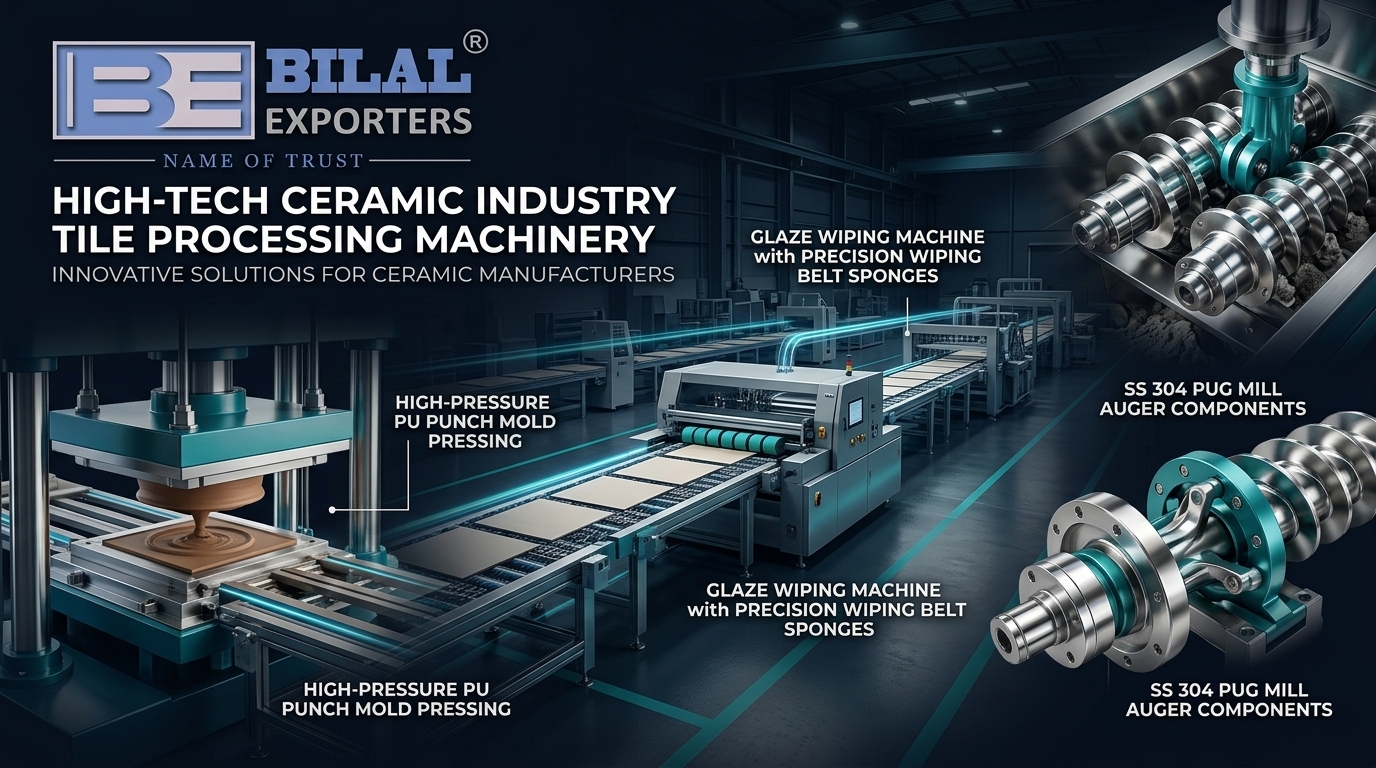
Engineered polyurethane glaze wiping belts manufactured by M/S. Bilal Exporters provide precise, automated mechanical removal of wet glaze slurry. Operating continuously on high-speed conveyor lines, these specialized belts ensure clean tile edges while preserving surface glaze integrity.
2. Selecting the Optimal Belt Thickness & Density (3mm vs 6mm)
Tile manufacturing lines operate under varying mechanical parameters. Determining whether to deploy a 3mm or 6mm thickness polyurethane wiping belt depends on line speed, tile thickness, and glaze viscosity:
| Belt Spec / Parameter |
3mm High-Speed Wiping Belt |
6mm Heavy-Duty Contour Belt |
| Line Conveyor Speed |
25 to 45 meters / minute |
10 to 25 meters / minute |
| Tile Type Suitability |
Porcelain Floor Tiles & Thin Slab Porcelain |
Heavy Vitrified Tiles & Relief Wall Tiles |
| Foam Pore Structure |
Micro-porous open cell (High water recovery) |
Resilient elastomeric cell matrix (Deep contouring) |
| Slurry Absorption Rate |
350 mL / m² / min |
650 mL / m² / min |
| Recommended Tension |
1.5 – 2.0 N/mm² |
2.5 – 3.2 N/mm² |
Why is 3mm belt thickness preferred for high-speed porcelain lines?
3mm polyurethane belts feature rapid mechanical recovery and low water retention mass, allowing the belt to absorb glaze slurry at conveyor speeds up to 45 m/min without slinging glaze onto adjacent tile faces or distorting under high centrifugal driving roller forces.
When should ceramic plant engineers specify 6mm belt thickness?
6mm belts provide deeper elastomeric compression, allowing the sponge belt to conform into deep bevels, rustic relief patterns, and heavy tile edge corners where thinner 3mm belts cannot maintain continuous contact.
3. Chemical Resistance & Hydrolysis Control in Glaze Environments
Ceramic glaze slurries consist of water-suspended frits, feldspar, kaolin clays, and dense mineral oxides. These compounds are abrasive and slightly alkaline (pH 8.5–10.5). Standard commercial polyurethane sponges disintegrate quickly under continuous chemical hydrolysis and mechanical friction.
Polyurethane glaze wiping belts by Bilal Exporters undergo specialized polyester/polyether cross-linking esterification. This chemical formulation ensures high tensile strength, superior tear resistance (>35 N/mm), and chemical hydrolysis resistance under continuous 24/7 ceramic factory operation.
4. Step-by-Step Maintenance Protocol for Plant Engineers
To extend belt service life beyond 500,000 tile passes and maintain streak-free edge cleaning, plant technicians should follow this 4-step preventative maintenance schedule:
- Daily Recirculation Flush: Flush wiping belts continuously with clean, temperature-controlled water (20–25°C) to prevent dried glaze frit crystallization inside open sponge pores.
- Roller Tension Alignment: Measure driving roller tension weekly using a digital tension gauge to ensure uniform 2.0 N/mm² pressure across the entire belt width, preventing diagonal stretch.
- Doctor Blade Scraper Calibration: Position stainless steel doctor blades at a precise 45° angle to squeeze out absorbed slurry without gouging the belt surface.
- Squeeze Roller Inspection: Check rubber squeeze rollers for uneven wear patterns that could leave wet streaks on tile edges.
5. Authoritative Technical Standards & Industry Citations
Our manufacturing and quality assurance testing protocols comply with international ceramics and materials standards:
- ISO 9001:2015 Quality Management Systems — Certified zero-defect manufacturing process control.
- ACIMAC Italian Association of Ceramic Machinery Manufacturers — Technical recommendations for glaze line edge cleaning equipment.
- ASTM D3574 Standard Test Methods for Flexible Cellular Polymers — Indentation force deflection and tensile strength verification.
6. Frequently Asked Questions (Glaze Wiping Technical FAQ)
How often should glaze wiping belts be replaced in high-capacity factories?
Under standard operating conditions with daily water flushing, Bilal Exporters polyurethane belts typically achieve 400,000 to 600,000 tile passes before replacement is required, lasting 3–4 times longer than standard rubber or low-density foam belts.
Can custom width and length glaze wiping belts be manufactured for European ceramic machinery?
Yes, M/S. Bilal Exporters custom fabricates polyurethane glaze wiping belts in widths from 50mm to 600mm and loop lengths tailored to SACMI, System Ceramics, Siti B&T, and LB ceramic production lines.
Need Technical Assistance for Your Glaze Line?
Consult with our ceramic engineering specialists to analyze your plant's glaze slurry viscosity, line speed, and belt tension parameters. Explore our Ceramic Plant Solutions or Request Evaluation Belt Samples.

Written & Reviewed by Mohamedsoyeb Bhurawala
Proprietor & Engineering Director, M/S. Bilal Exporters
Over 15 years of OEM manufacturing expertise in industrial polyurethane sponge formulation, ceramic tile polishing consumables, and global container freight supply chain management.